Ravish Sitar : Great for Ambient Music
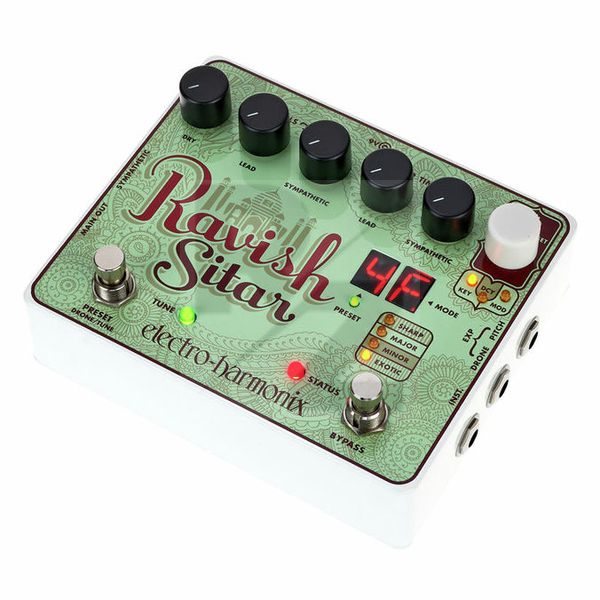
The Ravish Sitar guitar pedal from Electro Harmonix is in a category completely of its own. Basically what it does is to create two additional voices to the dry guitar signal. One is a synthesized emulation of the melody strings of an Indian sitar (referred to as lead). This voice is unison with the dry signal unless an expression pedal is used to pitch bend the signal (explained below). The other is a synthesized emulation of the sympathetic or resonant strings of the sitar (referred to as sympathetic) which can either losely follow the melody being played or remain static depending on how the pedal is used. The three signals, dry, lead, and sympathetic, can be mixed by the three leftmost knobs on the pedal, to create an impressive amount of sonic variation. The three rightmost knobs are for adjusting the timbre of the lead and sympathetic, as well as managing presets and getting into the more detailed functions of the pedal.
The Ravish Sitar has so many functions and uses that it would be beyond the scope of a user review to try to explain them all. Instead I would like to write a bit about my own experience with the pedal and how I use it live. First the sound itself: The lead does NOT sound like a real sitar, but rather a kind of filtered synthesizer sound that can be interesting in itself. However, the sympathetic sound is actually quite close to the real thing and can also be used as a tanbura-like drone either by pressing and holding the preset footswitch while playing or by using an expression pedal in the drone input (the latter also controls the level of the drone). Both these methods will produce a rich drone while the dry/lead can play melodic lines on top. The pedal accepts a second expression pedal in the pitch input, which will then function as a whammy pedal, although only pitch shifting the lead signal and only upwards (up to an octave). I find this less useful for embellishing melodic lines, but I sometimes use it for pitching the lead a fifth above the dry signal in a whole section of a song, giving some interesting melodic sounds as well as chord possibilities. The dry/lead and the sympathtic have dedicated outputs and can be processed separately, or they can be summed in the pedal (I keep them separate).
I find both the drone and the pitch shifting useful for playing ambient music (which I do), and I will use the pedal for several songs in a set. For rock, pop, jazz etc. I think the pedal is more of a "novelty" effect to be used for 1-2 songs in a whole set. That's just my opinion, some might find more use for the synth-like lead than I do.
Apart from the lead not really sounding like a sitar, my only complaint is that the footswitches are too noisy, which is problematic for quiet music in smaller venues. A thing I found problematic at first: The sympathetic output sends the dry signal when the pedal is bypassed. Now I find that to be an advantage, however, as the pedal effectively functions as a splitter. It has to be taken into account when you make your setup, though.
In any case, the pedal is lots of fun to play around with and it gives a lot of inspiration and possibilities. I highly recommend it.
Technical Data
- Manufactured by Electro Harmonix
- Released in 2011
- Average price : $279
You may also like

2023 100%

2023 100%

2023 100%

2023 100%

2023 100%

2023 100%

2023 100%

2023 100%


2023 100%