Multi Stomp MS-50G : A severely underappreciated gem!
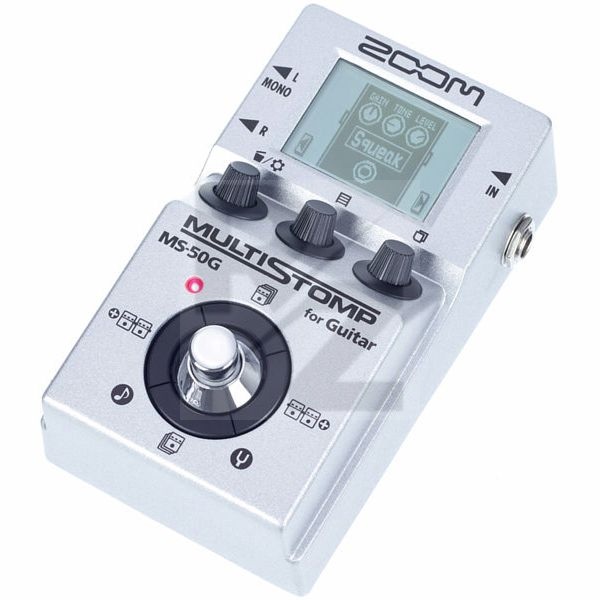
There is a reason why the Zoom MS-50G MultiStomp has remained on the market for over a decade. Do not let its comparably low price fool you into thinking that it is an amateurish toy. It is not. While its pixelated display and cute icons might make it look like an oversized rectangular Tamagotchi, there is a capable multi-effects unit under the skin. With such respectable specifications as 24-bit analog-to-digital (and vice versa) conversion and 32-bit floating-point signal processing, it can easily keep up with today's best.
Build quality: Unlike some other Zoom multi-effects pedals, the MS-50G is made out of metal. The only plastic parts are the screen, the battery compartment cover, the knobs, and the buttons. Speaking of buttons, they give off a satisfying click and feel sturdy. The knobs, however, do not inspire as much confidence, but they are placed in such a way that stepping on them by accident is highly unlikely. If I wore a hat, I would raise it to the Zoom designers because the layout of the buttons and knobs is nothing short of ingenious!
Handling: The user interface is so intuitive, that I was able to figure it out without a single glance at the included user manual! Truly, it could hardly be made any better: the physical knobs below the pedal's display correspond to the virtual knobs shown on screen, and the buttons surrounding the footswitch are used for navigating the menus. Yes, it is true that the buttons cannot be operated hands-free, but this pedal was designed to save space. For those who need to easily change settings on the fly, there are many times larger Zoom units with multiple footswitches. The settings on the MS-50G are highly customizable, but only if you want to. The menus are cleverly structured in such a way that you do not have to scroll past the settings that you will likely never need every time you want to perform some basic task. In short, the unit does not overwhelm the user with its wide array of options. Yes, the cute pixelated icons might look Tamagotchi-like, but they make it much easier to differentiate one emulation or effect from another than the more serious-looking geometric shapes on the Boss and Line 6 alternatives. I consider myself a visually-oriented person, so to me, Zoom UI is the best. I never need to put on my eyeglasses to read some tiny letters — a picture is worth a thousand words, as they say. The only criticism I have in regard to this pedal and its features is that it lacks a headphone jack. It would be great to be able to plug my headphones straight into the unit for practicing at night, for example. But I liked it so much, that I bought its slightly larger sibling, the Zoom G1 Four, which not only has a headphone jack but also a built-in 30-second looper!
Sound quality: Since I mostly play “clean”, I am not the right person to comment on the “dirty” tones, but I will say that the ones I have tried so far did not sound artificial at all. Rather convincing, in fact, especially when used in the mix. The key to success, I think, is to discard all the factory presets (nearly all of which sounded pretty terrible to me, to be fair) and create your own by carefully adjusting each parameter to suit your playing style and instrument. I did exactly that and was shocked by how much better my tone was (to my ears, at least). I think, the reason some people do not like the sound is that they judge it based on the factory presets. Personally, in less than a quarter of an hour, I was able to dial in a pretty spot-on Fender Twin. The same with a Vox AC30. I believe that the main problem here is that we tend to judge equipment based on its price. Just because something is cheap or — God forbid! — digital, does not at all mean that it has to sound worse. Yes, it is lovely to think oneself a gourmet of tone, able to notice the difference between a Duracell and an Energizer battery in a vintage Dunlop Fuzz Face, but is it really worth spending 20% of your life chasing a mere 2% improvement in tone? For me, it is not, so the MS-50G serves me just fine. I look at it as a whole bunch of plug-ins in a box. Give it a try and perform some blind-tests, and it might just surprise you!
Technical Data
- Manufactured by Zoom
- Released in 2012
- Average price : $126
You may also like

2023 100%

2023 100%

2023 100%

2023 100%

2023 100%

2023 100%

2023 100%

2023 100%


2023 100%