Aodyo Anyma Phi
Monophonic Physical Modelling Desktop Synthesiser
Latest User Reviews
I like this synth -
Context: I write this review after testing/investigating this synth for a few days only.
Quality in general, the build quality and the sound quality is very good.
Technical Quality / Engineering:
One common issue I found with a lot of the currently upcoming (mostly) ARM processor based instruments and FX devices is processor noise creeping into the signal path. I haven't found this so far in the Aodyo Anyma Phi.
It allows easily - and mot important reliably - monitoring the CPU load in real time while creating the sounds to avoid glitches due to overload. The processor is powerful enough and I haven't maxed it out so far.
I only found minor display issues with control software (MacOs Monterey) that probably will be fixed in a future update.
Sound Quality:
Both parts the physical-modelling sound engine and the analog-modelling sound engine sound very good. The oscillators have their own distinct colours (in a good way, it defines the instrument's own character)
Same for the filters.
Even the - in the digital realm notoriously difficult - reverb (when dealing with such limited computing powers) sound good. Due to it's audio input it also qualifies as a good multi FX unit for external instruments.
Features:
it is an extremely feature rich instrument so I will only mention a few that are special to this synth:
It can dynamically mix audio inputs with the synthesised sounds - including e.g. mapping the input sound to the envelopes and most other sound params. This opens up a rich space for live sound design.
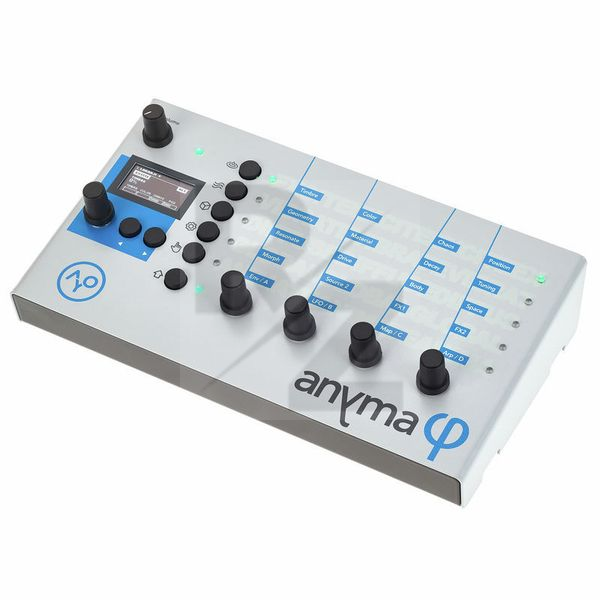
There is a build in piezo transducer, that allows to use the case of the Anyma Phi e.g. as a physical percussion instrument by tapping it.
Handling:
It is a complex device and reading the manual helps understaning its potencial. The engineers and designers did a good job of translating the vast amount of controls to a relative simple interface with a few buttons. Especially for live/on stage sound manipulations. It's partially intuitive, and partially needs learning.
For sound designs from scratch I recommend the using the app.
Summary:
To me it is a device that immediately gets me inspired in creation. It convinces as well in sounds that aim for naturalistic imitations of acoustic instruments, analog synth sounds and for avanguard/experimental sound design. It is a musical instrument and as such it needs learning and studying it.
Minor nitpicks:
The control app could see a improvement in terms of readability and clarity.
Wishes left open:
A polyphonic version of this! I'd queue in line to get it :) and it would probably become my main instrument.
Technical Data
- Manufactured by Aodyo
- Released in 2021
- Average price : $541
- Simulates various acoustic sound sources such as resonators, organ pipes and strings
- Can also be used as an effects unit via audio input
- 3 Oscillators
- Effects: Resonators (filter), EQ delay, reverb chorus, phaser drive and folder
- Up to 8 modulators such as envelopes, LFOs, logic modules and slew limiters
- Functions such as arpeggiator and MIDI clock sync, microtuning support, autofill matrix and randomize patch, virtual analogue and FM operator, granular and dynamic processors
- 5x4 matrix editor
- Up to 200 patches can be stored
- Display
- Internal piezoelectric microphone (if nothing is connected to the line input)
- Percussive playing surface
- Patch library / editor
- 1 Stereo line input: 6.3 mm jack
- 2 Line outputs: 6.3 mm jack
- Stereo headphone output: 6.3 mm jack
- MIDI input and output
- 2 USB ports
- Desktop enclosure
- Weight : 0.9kg
You may also like

2023 100%

2023 100%


2023

2022 100%

2022 100%

2022 100%

2022 100%

2022 100%