ASM Hydrasynth Explorer 5-stars Reviews
Miniature Marvel
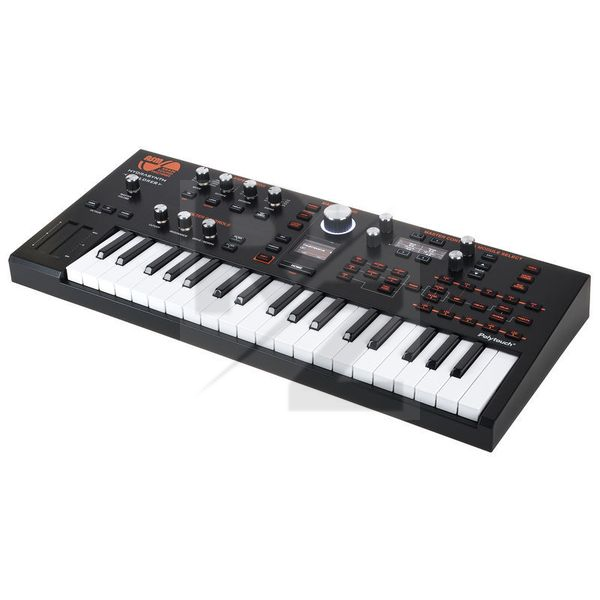
The Explorer is a fantastic small synth with incredible sounds and has a lot of options for sound design. It is great that you get the same sound engine as the larger versions. The keybed is really nice especially for a mini size and the polyphonic aftertouch is well implemented.
If you are looking for small sized synth, this should be on your list.
awesome synth
what an awesome little synth. tons of modulation, really good sound and logical menu diving.
Flexible digital synth
As a newbiee to the world of synthesisers I have to admit this one is fairly complex. The possibilities seems endless which is exciting and challenging.
I have found some preferred ways of working with it - maybe a bit simplistic with focus on som sine and sub- tones.
Either way, when starting to play hours fly and I am having a good time.
I am looking forward to exploring it more and applying it in my practice.
(I also plan to read the manual)
Seemingly endless array of options, actually pretty easy to use too
This smaller synth has: no non-sense user interface (in fact it very usable); top drawers sound quality: there’s a clarity and depth to the sound which is quite impressive.
The ‘module select’ buttons form a schematic which details the signal path within, from three oscillators through mutators, ring-noise, mixer, two filters, five LFOs, five envelopes, pre-FX, delay, reverb and post-FX.
For this price point it is remarkable the presence of polyphonic aftertouch (each note can be modulated independently by applying additional pressure while holding down keys.)
Alkaline batteries is a nice alternative but keep in mind that battery life is limited to a few hours.
“Portable”, in this case, has to be intended only in the most technical of senses.
In the end: a seemingly endless array of options, actually pretty easy to use too.
All I need as a beginning synth player and sound designer
Endless sound possibilities with the wavescan, wavestack, aftertouch... The sounds can be gigantic and complex. The small keyboard is known to be the best in it's class and I believe it. Perfect size for me, I combine it with the keystep 37, so I can play 6 octaves. The arpegiator is nice and easy to use, the chord modes are (voice and arp) perfect on a polyphonic synth. What I miss is a good sequencer like the 37 and an option to save modules seperately.
Stellar, as expected
I'm a mainly a bassist by trade, synth studio dweller by night. Bought mainly for a do-it-all keybass and a main desk synth / midi-controller
Having caught the hydra-bug when the original models released, and after steadily studying the manual thereafter, considering making the (rather sizeable) purchase , I jumped at the offer of the exact same engine, but in a smaller, more desk-friendly formfactor, AND with a smaller price-tag.
Despite the rather large amount of expectations I had grown during the wait, the Explorer dissapointed in no regard. I'll go by the list of initial concerns, and how they were met:
1. Keybed
Playability is paramount to me, so this requirement had to be met. The intstrument has mini-keys, as they had to be considering the width available. Despite this they don't feel like a significant compromise, and the feel is by far the best I've felt. No rattling, no plasticy of flimsy feel, a suprisingly sturdy response and fast, tactile action. I also didn't expect the poly-aftertouch to feel so natural, despite the small travel space. You really have to dig into the keybed to hit 127, way more headroom than I would ever need for my playing. 3 octaves is enough for expressing harmonic ideas on two hands, and besides I can always turn to my 88 master keyboard If i need more (though I lack the polytouch on mine. (hint hint, ASM...))
2. The lack of space
Definitely not a big problem. once I got used to the button layout, I patching mods as fast as I could think of them. I'd say I have 90% of the speed I have programming my knob-per-function prologue. Having every control really close by is great for performance and one hand playability. (Also the filter knob and volume being by the mod-strips is a great touch, as I am always riding on those when performing)
3. Overall quality
Solid, good weight, STURDY knobs. I try to wiggle one and the whole table shakes, I think that says enough. Doesn't feel like a corner-cut downsize unlike some other mini-synths.
Overall pros and cons:
Pros:
- Giggable, fits in my backpack.
- Well built.
- Way more features than I could need, but without feeling overwhelming - by virtue of the excellent ux. Feels like you can't hit a limit or creative roadblock when patching.
- Polytouch + touchstrips + bucketloads of mods + random button= Most expressive piece of gear I own, in terms of sound-design AND playing.
- Also sounds excellent, which is most important.
- 600 eurobucks. You can't beat that.
Cons:
- "No" step sequenser. Though the arp and lfos(!) allow the possibility of stepped, chromatic sequensing, and I don't know where they could even fit a fully featured one. If they tried to cram more power into a space this small I think it would cause a supernova.
If you're on the edge, I'd say just buy it. Support great synth-design.
You may also like

2023 100%

2023 93%

2023 60%


2023

2023


2023

2023