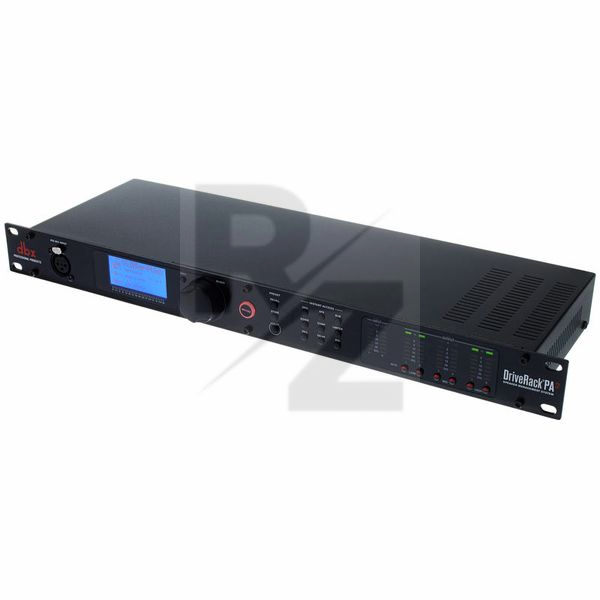
DBX DriveRack PA2
Digital Speaker Management System
Latest User Reviews
Not reliable
We have few units and all is giving same issue after period time firmware get corrupted , would not recommend it
Price/quality rate unbeatable
I use a driverack pa2 to run my 2 way passive system ( subs + midtops ) i love the simplicity and the intuitivity of it. The smartphone app is so easy to use and is really usefull, expecially in those situations where the processing gear is not in front of the speakers and the foh engeneer would have to go back and forth to change any setting and listen. The wizards are indeed useful for the unexperienced user to start his setup. There's much one could say about this device's sound, its capabilities and its limits.. but i will just say this is the best you can get with so little money, if you need an entry level audio processor this is the one to buy.
Best affordable sound processor
Best affordable sound processor. If you need a good calibration of the venue, this one is a must.
very good to manage sound
Greet for performers who want real sound quality
Very usable to tune your speakers at the venue place to get from your speaker's maximum quality of sound. Also to deal with feedback. Would recommend a friend.
Good quality from DBX
We have two of these units in our rig, great feature is being able to control the setting over Ethernet via a wireless access point from an iPad. Usual high DBX quality product.
One of The Tools to make your speakers play nice with each other!
This is what makes my speakers play nice at home, and someone else's speakers play nice elsewhere when setting up PA in smallish venues. If you bother learning some of the science behind what this device is for, it'll pay you back in sound quality. The best results are achieved when you have multiple amplifiers and speakers to be driven and spend the extra time to configure the crossover and phase alignment delays before AutoEQing. Also, as usual for dbx rack gear, this one lacks a power switch as well.
This unit has a single stereo/mono input with three stereo outputs of which the LOW output can be configured mono for single subwoofer use. I suggest reading the manual to find out more about the features. (Yes, RTFM before buying!) Some special cases will need a bit more manual tinkering, eg. setting up a PA with three subwoofers. (Yes, one of the setups I did had a full-range stereo pair from HIGH outputs, stereo subwoofers from MID outputs, and a third mono subwoofer in the middle in front of the stage from the LOW output, and it was awesome!)
Originally I was looking for just an analog stereo EQ to overcome some of the acoustic problems at home but started looking at digital speaker management systems instead as the entry level devices weren't that much more expensive and came with a lot of other features which would need a bunch more separate devices in the analog world. The dbx DriveRack® PA2 ended up being my choice with the matching RTA microphone as the cheaper option had (luckily!) just run out of stock. And then it also found use where it's at its best, smaller scale live sound reinforcement.
So far the PA2 (firmware version 1.2.0.1) has locked up only when starting some Wizard features. External app connections will drop when this happens. This eats one of the quality stars, because setting up is one of the times when you want your tools to work. However, it's never done anything stupid after setting up and in production use, so I'll live with the occasional Wizard crash. The Mac software interface follows the layout of the iOS app and is slightly less responsive but does work. The iOS app has proved to be useful to tweak EQ, compressor, and such on the fly while the rack unit itself is somewhere out of reach.
The first A/B comparisons I did with a single stereo output, just with AutoEQ and nothing else, blew my mind with the improvement to the previous EQ-less setup. Later on I tried bi-amping a pair of passive speakers that offered the option. I set up the crossover with the speaker specs and finetuned it by ear, then used the output delay to phase match the tweeters with the full range drivers before AutoEQing. The improved clarity around the crossover range just... I don't have words for it. Let's say it just made an already great pair of speakers sound even better, and there's no going back to a single-amp setup!
The AutoEQ has proved to be great to set the baseline EQ for whatever acoustics the venue happens to have. Sometimes the larger corrections need to be dialed back a little by hand, but that's never been much of a hassle compared to doing the whole EQ setup from scratch. The apps offer you a calculated dynamically updating frequency response result graph when doing AutoEQ fine tunes by hand. The graphic EQ isn't used much by me, but I sometimes use it to make small fine tunes at select troublesome frequencies that resonate in some particular spots of a venue.
Configuring which outputs are enabled can only be done through the Wizard, which takes away half of the handling stars. When setting up special setups you will need to think which wizard choices enable what you need and then set up the crossover manually. I'd prefer a possibility to just enable and configure each output freely instead.
When doing output phase matching, I've used my iPhone and iPad at the same time because the phase inversion button and the alignment delay slider aren't on the same view in the app. This chews another half of a handling star since access to both are often needed at the same time! At the front panel this works fine as switching back and forth between the pre-selected settings happens with separate buttons, but you most likely don't have your PA2 installed in the middle of the venue at the sweet spot where you listen while setting up.
I have also used the PA2's RTA to set up separate EQs, eg. for monitors which are completely separate from the main PA. Just play pink noise through the system you're tuning and use the PA2's analyser to measure the frequency response, just like it used to be done before fancy AutoEQs. This method also works while setting up the crossover to make sure you have an even response around the crossover frequencies. PA2 has a noise generator for this purpose.
The compressor is a nice touch in this thing. So far I haven't needed it to make the PA louder, but I've used it a lot as a soft limiter with 2.4:1 ratio and the OverEasy setting around 4-6, just to keep peak volume in control when playing loud.
The feedback suppressor has been a great trouble solver for what little use I've had for it. The subharmonic synth has been mostly useless for me.
I haven't really used the output side parametric EQs but I've thought of a situation where I'd use the PA2 as a splitter and AutoEQ each output pair separately as needed, then manually transfer the AutoEQ settings to the output PEQs. I haven't used the limiters yet as the amplifiers and active speakers I've used have had them built in, but I'm sure a properly tuned PA2 would do limiting better and more transparently as well.
Perfect sound for my sistem. I use it for my JBL JRX series & Peavey PV2600 amps.
Cons: it don't have On/Off button.
Easy to work with, sounds good, limited in features
I heard no real improvement in sound quality over my previous Behringer DCX2496. It also has a bit less features. I could not find how to do extended routing, for example, subs in mono (sum L+R). That seemed not be possible. Furthermore, the remote control with the app was quite unresponsive and slow.
The auto alignment I never use, always use good ears and acoustic software instead.
Easy to setup & use... and great results!
We installed and used the PA2 for the first time last night. This was my first experience of a speaker managment system, but it was so simple to setup. That's largely due to the wizards, which take you though the process step-by-step. The reason we purchased this product was so that we could add a subwoofer to our venue's sound system. It handles the cross-over very well. But it does so much more as well: feedback suppression; EQ the room... etc. We're very impressed with what we've seen so far. There are still more features we need to explore... but we'll do that during the next few months.
Technical Data
- Manufactured by DBX
- Released in 2014
- Average price : $510
- 31-Band graphic equaliser
- 8-Band parametric input EQ with auto EQ function
- Limiter
- Crossover
- Compressor
- Subharmonic synthesiser
- Output delay up to 3.4 m/10 ms
- Input delay up to 34 m/100 ms
- Feedback suppressor with 12 notch filters 1/80 octave
- 8-Band parametric output EQ also for speaker tuning
- 1/3 Octave band real time analyser
- Pink noise generator
- Remote control via Mac/Windows/Android/iOS
- 2 XLR inputs
- XLR input with 15 V phantom power for optional measuring microphone
- 6 XLR outputs male
- Ethernet connection
- USB connection
- Format: 19" / 1 U
You may also like

2022

2022

2022

2022

2022


2021 80%

2021

2020 100%