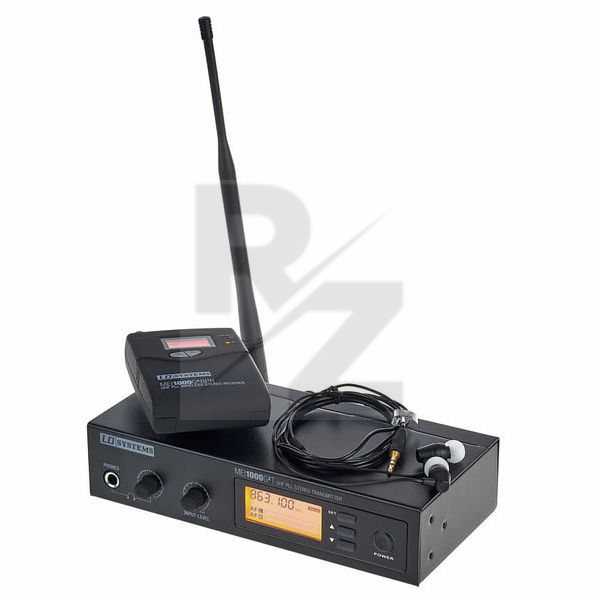
LD Systems MEI 1000 G2
UHF Wireless In-Ear System
Latest User Reviews
works fine for the money
bought these for rehearsal and live usage - its quite stable, there is a lot of transmission noise, but we could get used to it pretty much. of course there are more expensive which are much better, but this just does it well and its definitely an affordable upgrade compared to loud monitors.
Best priced wireless in-ears solution
Out of the box everything is well packaged and quick to set up. The plastic carrying case is fine for gig use travelling by car. A quick selection of channel gives you the best frequency for the room and to avoid any other band members using a similar system. The transmission is consistent but is mono unless you use two input cables. The transmission only very occasionally drops out while moving around but the sound quality is clear. For half the price of other brands, this is a great price point solution for most applications used with re-chargeable batteries. The pocket receiver unit does need to be handled with a bit of care but will withstand occasional drops.
There is no need to spend more for decent wireless in ear monitoring
I was told by many people, that any wireless in ear divices below 600.- are unusable and not even worth to be tried out.
This is why I decided to run a comparison between the LD Systems MEI 1000 G2 (299.-) and a Sennheiser ew IEM G4 (1'033.-).
Sound Quality:
The Sennheiser has better audio quality and less noise. The LD Systems quality is however enough for my requirements, and the noise is only audible when there is no sound being transmitted and I started to filter it out automatically after a short while.
Wireless IEMs seem to have an inherent issue with very low and very high frequency sounds. In this regards and specifically for bass guitar sound, the LD Systems is lacking. While the sennheiser handles low end better, it is still far from perfect and in essence not three times better than the LD Systems.
Build Quality:
Both senders are encased in a metal housing and have no advantage over one another. The sennheiser body pack has a metal housing as well and semms a lot sturdier than the LD Systems. Both devices have been in use in Live situations and I have dropped the LD Systems a few times already without noticing any subsequent issues. While the sennheiser will probably last longer than the LD Systems I don't think it will outlast it by more than 3 time.
Configurability:
The sennheiser offers more configurability options and a more intuitive menu. But within half an hour of fiddeling more I had the LD Systems setup just as good as the sennheiser.
Quality of Life Features:
The Sennheiser has a sync function to automatically set the body pack to the same frequency as the sender. If you need to change frequencies often, this might be quite nice. In my experience, once you have a good frequency distribution between all your wireless devices, there is seldom a need to change the frequencies.
The LD Systems body pack produces a loud pop when you turn it on. I therefore tend to turn it on before pluggin my head phones in. This is not an issue on the Sennheiser body pack.
Conclusion:
Yes the Sennheiser is better than the LD Systems, but not so much so, that it warrants a 700.- price increase. In my opinion this money is better spent in proper in ear monitoring head phones or devices like the Behringers PM16 Personal Mixers to improve your in ear monitoring sound sound. The LD Systems works for me to perfectly hear all 6 instruments in my (Folk Metal) Band. This is however mostly thanks to my good in ear head phones (Vision Ears Custom Fits) and the channel wise stereo panning I can create on my PM16.
One point in favor of the sennheiser or the slightly less expensive shure devices is their options to manage the frequencies of multiple devices from computer software, that calculated the perfect frequency distribution as well as automaticall avoids frequencies that are already in use (if you have a frequency scanner antenna).
But there are also free tools that will do this for you. The only difference is, that you need to enter the frequencies for each device manually.
Rating:
Assume that the Sennheiser gets a rating of 5 stars across. In terms of sound, the LD Systems is almos as good in the most important category: sound.
In regards to quality, the Sennheiser needs to outlast 3 sequentially bought LD Systems before justifying its price.
Both the lack in handling and features can be overcome by not requiering a plug and play solution and spending maybe an hour more for the initial setup
high quality product
great. high quality.
upgrated model from 100 to 1000
the "focus" function is very usefull!
Great basic IEM system
If you're not looking for a high-end system then this is ideal. The quality is good for the low end price. It's more rugged than cheaper systems and has all the basic functions you need. The body pack should last well and with decent ear pieces it sounds fine.
Used for years
Great budget wireless IEM system. I've used this for years and it's never missed a beat. I'm sure there are better sounding, fuller featured options on the market, but from the point of view of a working musician this has been consistently dependable.
Note: Ive never used the ear buds that came with... they're probably terrible sounding!? I've always used quality IEMs (at least triple drivers) and with custom moulded ear tips. The buds you use will make a massive difference!
Does the job well
I use it for LIVE and practice. I'm a vocalist. I used Shure 215's with this, and then later upgraded to JHAudio JHX3X custom IEMs.
Sound quality is OK. Mostly depending on sound isolation of the IEM's used.
Pros (for me):
*Does the job very well. Tested up to 4x units parallel, Most in my band use this model.
*good price to performance ratio.
*Stereo.
*Basic, easy to set up.
*Had no Range or dropout problems. Even reaching far away backstages.
*Never had problems with new or fully charged batteries. Lasts at-least 4h, depending on use. (volume)
Cons:
*When the batteries are low, it makes load unpleasant noise. (But I guess its good that it does not just die). Noise stops when you turn volume down on receiver pack. At that point, has enough juice to finish the song. But the "Warning" noise is terrible.
*Eats basic batteries. Does not come with rechargeables. I bought rechargeable batteries, so each session has fully charged set.
*Plastic receiver. Mine looks like it been dragged behind a car, but it still works.
*I am worried about antenna on receiver, it looks not very sturdy, so I've been looking after it.
* had to hack the mounts and create custom brackets to have two units fit in 1U rack slot. With Brackets provided, can only have one unit per 1U.
* The added earphones do make a sound and can be plugged in. That's about it. Poor sound isolation. But better then nothing in case of emergency.
Overall, after few year of using it, It still works, And I don't feel like upgrading, since I'm not a professional.
You get what you pay for
For a reasonable price you get a pretty solid IEM system. I bought this system for live use with my band. If you are coming from floor wedges, this is definitely an upgrade in any circumstance. However, it does not beat the high end models, which I will get into shortly.
The build quality is good and does not feel flimsy. The EQ boost to raise the lows and the highs is also nice to have. Navigating the channels and frequencies is cumbersome, there is no clear explanation to what frequencies the channels correspond.
As far as audio quality goes, it's ok. There is low volume noise, which is only noticeable when it's quiet and nothing is being played. The lows and highs are rolled off, which can be boosted by the built in EQ of the receiver pack. I transmitted a regular MP3 for testing and there is a definite loss of quality. Does it bother me live? Not at all.
If you are looking to step into the realm of IEMs, this is definitely a good budget system to start with!
Background noise !
I was hoping to use this as a wireless monitoring system when recording instruments, so as to get rid of the headphone cable which i would regularly walk on when getting up, which results in the headphones being stripped off my head brutally... Unfortunately, this device has a very bad noise to signal response ratio (on all channels), resulting in nearly as much background noise as original signal - useless to say that this makes it unusable for studio applications.
I tried different places in the studio to check for any interference with other gear, with the same (bad) result.
I was told that better quality requires higher price tags, too bad. I hope one day we can have latency-free wireless ear/headphones at an affordable price !
Does exactly what it says.
The device has worked great for me. Build quality of the rack ears seems a little flimsy, and the aerial is sometimes lose when I open my rack, but the sound quality is what you'd expect from UHF. I've had no problems with noise or white noise sweeps etc. Add some bottom-end boost at the desk, and it's totally workable. I play bass on stage and these things only go i think 80hz upwards and so sound a bit thin, so i prefer a little beef added at the desk. My IEMs are not great or moulded though. But I have tried it with beyer headphones as well.
Technical Data
- Manufactured by LD Systems
- Released in 2013
- Average price : $379
- Consists of 9.5" stereo transmitter MEI 1000 T, body pack receiver MEI 1000 BPR, and earphones
- Up to 8 systems simultaneously, and 160 selectable frequencies
- Frequency range: 823 - 832 MHz and 863 - 865 MHz
- Mono or stereo operation
- Integrated limiter up to +12 dB
- 2 jacks/XLR combination inputs
- Headphone output
- Operation with 2 AA batteries
- Detachable BNC antenna
- Includes rack mount, batteries, antenna cable for front mounting, and plastic case
You may also like

2023 90%


2023


2022 100%

2022 100%

2022 100%

2022 100%

2022 100%