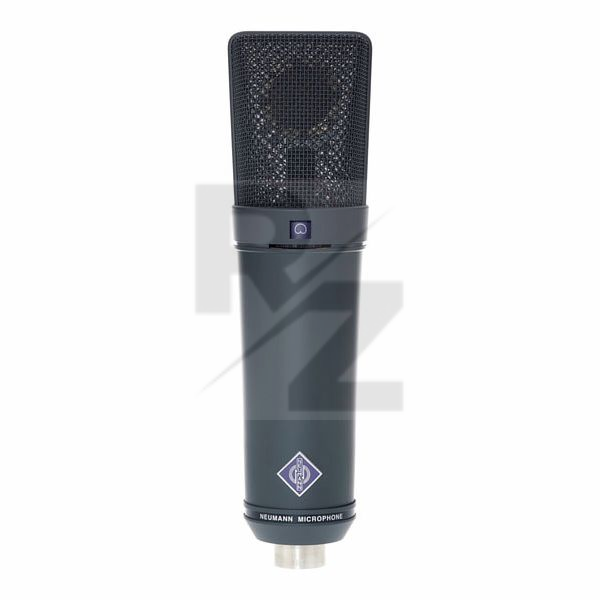
Neumann U89 I mt
Large Diaphragm Studio Microphone
Latest User Reviews
Versatile, honest, warm, open and dependable
This studio microphone perhaps requires a bit of knowledge, experiment and care for optimum usage; it may therefore deserve a bit more verbose review herewith.
Whichever task given, it proves one of the most versatile and useful microphones ever built, IMO. There are not many high-end models requiring only plain fantom power, yet featuring five perfectly set polar patterns, 6dB padding, two-step proximity effect roll-of, superb sonic resolution, warmth, clarity, sensitivity, frequency and dynamic ranges, longevity, ease of maintenance, combination of traditional discrete technology and modern full-range sound all-in-one.
I've used it in recording any sound source one can imagine; instruments somehow "like" it. Voices sound true and open. Classical guitar sounds alive. So does the trumpet. Complex, demanding sources such as grand pianos, orchestras, orchestral sections and drum kits get captured with great detail and separation - sounding three dimension like. Works great with large sources (such as pipe organs), which sound clean, also with distant sources. There may be certain "boutique microphones" which could perform in some of these tasks in a more engaging way, but not in each of them.
It is built around the robust K89 capsule, with diaphragms at ground voltage, being less susceptible to microscopic dust particles than most condenser mics, and therefore less costly to maintain if treated with care.
But the most important to me is that U89i provides a signal of very high quality and accuracy, which takes "down-stream" processing (EQ-ing, etc.) exceptionally well. This outstanding audio quality at the core of its signal is what makes the difference and justifies the price tag.
Although its popularity seems underrated in the popular music world (it gives pop-singing less "hype" than a U87Ai, but IMO also sounds more engaging, gratifying and midrange-honest than a modern C414): it's a classical standard, capturing sounds and music the way it should, even in less-than-optimal acoustic environments. Some "tech-influencers" nevertheless dare to write that it encourages sloppy recording work, which I strongly disagree. I've worked with U89s in studios for years before deciding to buy one for permanent use in my mobile/home studios, as a "workhorse", or a stand-by microphone or a so-called "desert island" microphone. It took me a while to afford one, but I find it worth the investment.
The same applies to both U89i and U89i mt.
Technical Data
- Manufactured by Neumann
- Released in 2008
- Average price : $3030
- Polar pattern: Switchable between omnidirectional, cardioid, figure-8
- Switchable 10 db attenuation
- Universally applicable: Vocals, speakers, overheads, wind instruments
- Transmission range 20 Hz ... 20 kHz
- Field transfer factor at 1 kHz at 1 kOhm 8 mV / Pa
- Nominal impedance: 150 Ohm
- Nominal load impedance: 1000 Ohm
- Replacement noise level (CCIR 468-3): 28 dB
- Spare noise level (DIN / IEC 651): 17 dB-A
- Noise level difference (CCIR 468-3): 66 dB
- Noise level difference (DIN / IEC 651): 77 dB
- Boundary sound pressure level for K <0.5%: 134 dB
- Boundary sound pressure level for K <0.5% with pre-attenuation: 140 dB
- Maximum output voltage: 800 mV
- Dynamic range of the amplifier (DIN / IEC 651): 117 dB
- Supply voltage: 48 V ± 4 V
- Current consumption: 0.8 mA
- Weight : 400g
- Diameter: 46 mm / Length: 185 mm
- Colour: Matte black
You may also like

2023 100%


2023 100%

2023 90%
2023 80%

2023 73%